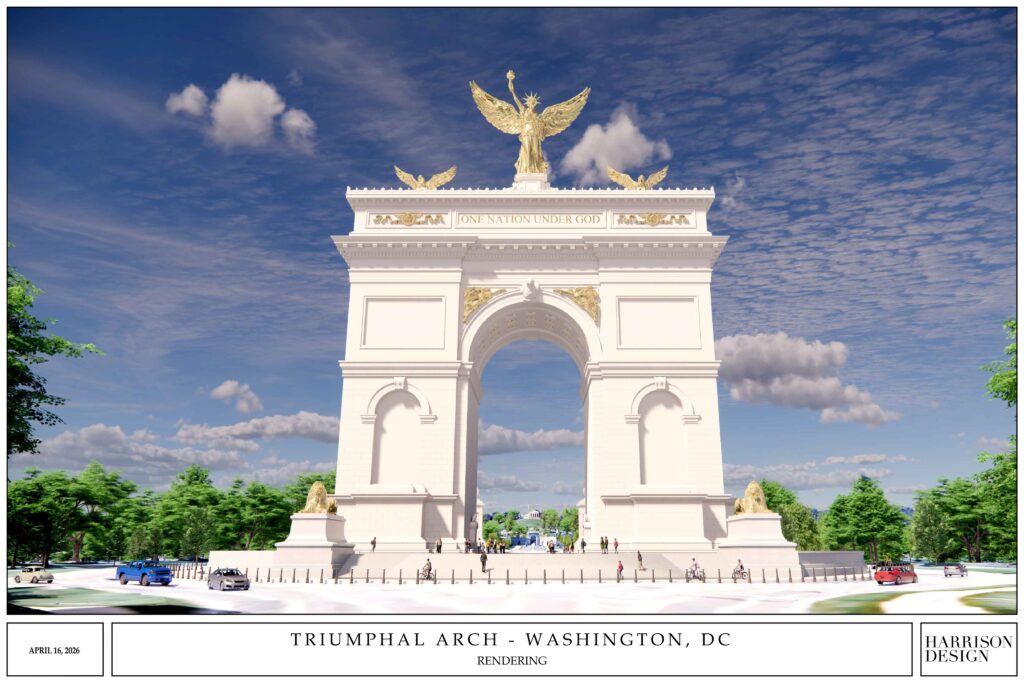
The Trump administration on Friday released new renderings for a proposed triumphal arch, a 250-foot structure intended to rise above a traffic circle near Arlington National Cemetery in Washington, D.C.
The monument, officially named “Independence Arch,” is part of President Donald Trump’s broader initiative to reshape the architectural landscape of the nation’s capital and to mark the 250th anniversary of the signing of the Declaration of Independence.
“The Triumphal Arch in Memorial Circle is going to be one of the most iconic landmarks not only in Washington, D.C., but throughout the world,” said Davis Ingle, a White House spokesperson. “It will enhance the visitor experience at Arlington National Cemetery for veterans, the families of the fallen, and all Americans alike, serving as a visual reminder of the noble sacrifices borne by so many American heroes throughout our 250-year history.”
According to design documents filed Friday by the Interior Department with the Commission of Fine Arts, the main arch structure would reach 166 feet in height. The design also calls for two 24-foot golden eagles mounted on plinths, along with a 60-foot gilded and winged figure of Lady Liberty holding a torch atop the arch.
The Commission of Fine Arts is scheduled to review the proposal at a meeting next week.
The interior archway would span 55 feet in width, roughly equivalent to four lanes of traffic, and rise 110 feet in height on the inside. That figure would surpass the height of the Lincoln Memorial, which stands at 99 feet and is located on the opposite bank of the Potomac River, directly parallel to the proposed structure.
The phrase “One Nation Under God” would be inscribed in gold lettering across the top of the arch. Four gold lions would be placed on pedestals at each corner of the base. The design also incorporates two upper-level observation decks, one of which would be designated for public viewing.
The proposed site is Memorial Circle, a traffic circle located just inside the District of Columbia’s boundary. The area falls under the regulatory framework of the Commemorative Works Act, which governs development standards in that section of the city.